
Why Enterprises Need a Centralized AI Evaluation Platform

Vendor-provided evals help you test one product. Independent benchmarking helps you set the bar for every AI system you buy or build.
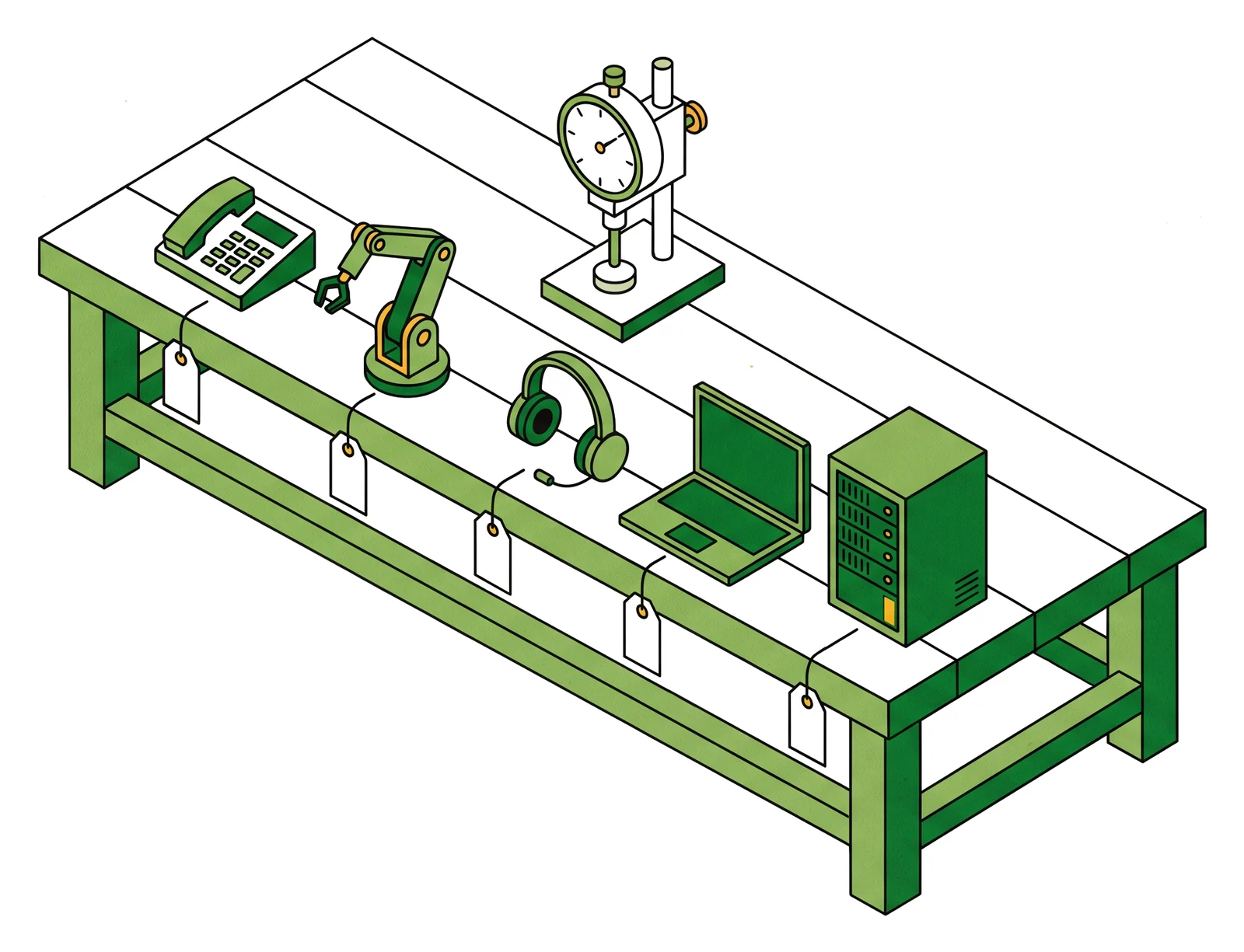
Imagine your first AI vendor comes with an evaluation dashboard. Your second comes with another. Then AI reaches more of the business, and a simple question becomes hard to answer: how well are all these systems actually working?
For an enterprise planning to deploy AI across the organization, evaluation cannot stay a collection of vendor-specific tools. You need a way to compare alternatives, enforce your own policies, and understand the quality of the systems you have already deployed.
Definition
A centralized AI evaluation platform is shared infrastructure for testing vendor-provided and internally built AI systems against enterprise-defined tasks, policies and acceptance criteria. When it is vendor-neutral, the measurement process belongs to your organization rather than to the provider of the agent being tested.
That is the case for independent benchmarking: buy or build the AI systems that work best for each job, but keep control of how you decide whether they are good enough.
AI adoption creates a portfolio, not a single deployment
You might start with a coding agent for engineering and a voice agent for customer service. But your planning horizon is not those first two purchases. It is an organization where AI supports many applications, teams and functions.
That means working with more than model providers. Your stack can include agent harnesses that orchestrate models and tools, specialized agent vendors, and SaaS products with AI built into existing workflows. Alongside them sit the systems your own developers and employees create.
When each system brings its own evals, simulation environment and reporting, every new deployment adds another place to look for evidence. Understanding the state of AI across the company becomes an exercise in reconciling separate reports.
Illustration · one company's AI portfolio
Eight systems, eight definitions of passing.
An illustration, not a customer's data. Each number may be honest. None of them can be compared with another, and none is measured against the company's own rules.
The problem is not simply too many dashboards. It is too many definitions of what passing means.
A portfolio also means the right answer differs by job. On the three benchmarks we publish, three different agents lead, and where an agent stands on one job says little about where it stands on another.
Veris public benchmarks
Three jobs, three different leaders.
AML Bench
Investigate an anti-money-laundering case in a simulated bank, and file the decision.70.6%GPT-6.1 SolTreasuryQA
Find one figure in an archive of 1,435 scanned Treasury volumes.64.8%Claude Opus 5.5VAmoS Pro
Take a utility's billing and payment calls, over noise, from calm or angry callers.44.7%Grok VoiceEach bench defines pass@1 for its own job, so the two columns are not interchangeable, and that is the point. Gemini 3.8 Flash is last of eleven on AML Bench and fourth of eight on TreasuryQA. Grok 4.7 is mid-table on one and second from last on the other. Bars run to 75%.
Compare AI vendors on the same tasks and conditions
Consider a voice agent for customer support. Decagon's Simulations, for example, is described as a way to test Decagon agents across scenarios, including voice-specific conditions. Sierra's Voice Sims, part of its Agent Studio, puts voice agents in front of simulated callers with different needs, accents and emotional states. Both can be valuable for developing and improving an agent within each platform.
Now imagine you choose one of them and are satisfied with the results. A year later, the other, or a new competitor, claims better accuracy, lower latency or lower cost. You want to know whether it would actually perform better on your customer calls, under your policies, with your systems.
Testing the incumbent in Decagon's simulations and the challenger in Sierra's, or the other way round, does not answer that question. The scenarios, simulated users, starting data, grading rules and definitions of success may all differ. Two scores can look comparable while measuring different things.
Unless a vendor's testing system explicitly supports neutral evaluation of outside agents, you cannot rely on it for that comparison. Access to both vendors' dashboards still leaves you with two separate experiments.
An enterprise-owned benchmark changes the setup. Both candidates attempt the same job from equivalent starting conditions, with the same policies, success criteria and test protocol. For a voice agent, that means the same caller intents, interruptions, escalation requirements and backend tasks.
VAmoS Pro Bench · 100 calls · three runs each
Same language model, same prompt, same tools. Twice the success rate.
Task completion on VAmoS Pro Bench, a utility's billing and payment line. The three stacks marked in amber use the exact same speech-to-text, language model and voice, and still range from 17.3% to 29.4%. What differs is everything around the model: who hears the caller, who decides the caller has finished, who speaks. These are our bridge configurations, not each vendor's best, and the board publishes them.
For stateful tasks, each attempt needs its own isolated world, so one candidate's actions cannot affect another's test. Repeated attempts help separate consistent behavior from a lucky run. Relevant configuration, resource budgets and unavoidable differences should be recorded rather than hidden.
Now you can examine the tradeoffs directly: better task completion, but more policy failures; lower cost, but slower conversations. The purpose is not to pick a universal winner. It is to identify the right system for your requirements.
VAmoS Pro Bench · six of fourteen stacks
Three measures, three different winners.
The stack that completes the most calls is not the fastest or the cheapest. Which one is right depends on what your calls need. Costs are at each vendor's published prices.
Your providers can compete to perform better without each supplying a different exam.
Turn company-wide policies into shared acceptance tests
Vendor comparison is only one part of the problem. An enterprise also needs to say: every AI system we deploy must meet these minimum requirements.
Those requirements should not depend on which vendor happens to supply the agent. With separate evaluation systems, you must translate the same requirements into each vendor's test format, check that each one exercises them adequately, and interpret different kinds of evidence. When a policy changes, that work repeats across the portfolio.
A central benchmarking platform lets the organization define the policy, the scenarios that exercise it, and the evidence required to demonstrate compliance. Each system is then tested against the applicable baseline instead of a vendor-specific interpretation of it.
A common baseline does not mean identical tests for every application. A coding agent and a customer-service voice agent do different jobs, so they need task-specific benchmarks alongside the shared requirements wherever the same policy applies. Riskier deployments may need a higher bar.
The company owns the standard. Each team demonstrates that its system meets it.
Get an organization-wide view of quality, risks and tradeoffs
Without a shared measurement layer, reviewing the state of enterprise AI means visiting separate systems and asking separate teams to explain separate scores. Auditing the evidence takes the same fragmented effort.
A central platform should show which systems have been evaluated, which versions were tested, which requirements they passed, where they failed, and what remains untested. Results should lead back to the underlying scenarios, traces and outcomes, not stop at a green status light.
Illustration · the portfolio on one page
One standard, applied where it fits, with the gaps in plain sight.
bought
bought
SaaS feature
built in-house
employee-built
An illustration, not a customer's data. "Stale" means the system's configuration changed after its last run. Every mark should open onto the scenarios, traces and outcomes behind it.
That gives engineering, procurement and risk teams a common basis for review. They can identify recurring failure modes, inspect quality and cost tradeoffs, and tell a recently tested deployment from one whose evidence no longer matches its current configuration.
This is not about averaging unrelated scores into one enterprise-wide number. A coding score and a voice-agent score do not become interchangeable because they appear on the same page. Centralization should preserve the meaning of each measurement while making coverage and policy status visible across the organization.
It is also more than a dashboard that imports vendor reports. Consolidating the display does not standardize the experiments behind it.
Separate the agent provider from the acceptance decision
There is a structural conflict of interest when the company selling an AI system also controls the evidence used to approve it. The vendor has a commercial interest in adoption. The buyer needs a test that can conclude the product is unsuitable, or that a competitor is a better fit.
That does not require anyone to manipulate a score. Choices about scenario coverage, failure definitions, scoring weights and which results receive attention can all shape the conclusion. Those choices should reflect the buyer's requirements, not simply the product's strengths.
Vendor testing is useful evidence, but it should not be the only evidence. An independent evaluation layer separates improving a product from deciding whether that product clears the enterprise's acceptance bar.
Independent does not mean infallible. A third-party evaluator is also a vendor. The organization should retain access to its test definitions and results, inspect the methodology, and approve the acceptance criteria. The goal is accountable measurement, not outsourcing judgment to a different black box.
Make evaluation a core product, not a supporting feature
Conflicts of interest and product focus are different issues. Even a vendor acting entirely in good faith has to choose where to invest its engineering effort.
For an agent vendor, the core product is the agent. Evaluation helps customers configure it, validate it and start using it. At its minimum, a built-in eval or simulation tool is an onboarding requirement: enough testing infrastructure to get a customer who has none comfortable deploying the main product.
That creates a long-term risk for the enterprise. What you treat as critical quality-assurance infrastructure may remain a supporting feature on someone else's roadmap, rather than the flagship product receiving sustained attention.
Some agent vendors invest substantially in testing, and not every bundled tool is minimal. The point is that making one vendor's agent better and building a comprehensive, cross-vendor evaluation platform are different product missions. A specialist platform should be accountable for four things, and you should ask for evidence of each. Neither an independent label nor a claim to be state of the art proves them.
Stateful replicas of your systems and believable people, so the agent does real work rather than answering a script.
Scenarios drawn from your policies and incidents, edge cases on purpose, and repeated runs to separate consistency from luck.
Checks on what the agent did and the state it left, with judges you can inspect and criteria your team approves.
Every number traceable to its scenarios, traces and outcomes, with the configuration that produced it.
Hold internally built AI agents to the same deployment bar
This infrastructure is not just for third-party products. Your own developers may build an agent. An employee may assemble an AI workflow inside a tool the company already uses. Those systems need a clear path from a promising prototype to an approved deployment.
Being built internally is not an exemption from quality assurance. Before an agent is adopted widely or put in front of customers, it should demonstrate that it meets the applicable minimum requirements, just as a purchased system must.
Internal teams can keep their development tests and debugging tools. The central evaluation and benchmarking layer provides the shared acceptance process: the same policies, evidence requirements and review expectations for systems built inside or bought outside the company.
Otherwise the organization risks two standards: one for vendors going through procurement, and another for internal projects reaching production through a different door.
The question is what the system can do and whether it does it reliably under your rules, not where it was built.
Centralize measurement so teams can move faster
A central platform should not mean a central team manually approving every experiment. The objective is to make evaluation reusable and accessible, so teams can test early against known requirements instead of discovering the approval criteria at the end.
Build the relevant simulation environments, policy checks and reporting conventions once, then reuse them where they apply. A new internal agent should not require reinventing the test harness. Evaluating a replacement vendor should not require abandoning the benchmark that already captures your business requirements.
This is where provider independence becomes practical. The evaluation infrastructure survives a change in the system being evaluated. You can consider a new model, agent harness or complete vendor product without handing over control of the standard used to judge it.
VAmoS Pro Bench · the same 100 calls
The exam stayed put. The candidates changed.
Task completion, reply time and cost for two model generations, measured on the same exam with the same callers, systems and grading. The upgrade decision gets numbers instead of a release note.
Vendor-native tools still have a role. They can help teams develop and debug within a product. The central platform serves a different purpose: enterprise-owned comparison, acceptance and review across products. Keep the development tools that help each team move quickly. Share the measurement infrastructure that tells the organization whether those systems are ready.
Your AI providers will change. Your standards should remain yours.
This is the role we see for Veris: independent simulation and benchmarking infrastructure for the agents an enterprise buys and builds. Veris for benchmarking centers the test on your policies, workflows and systems, with simulated environments, repeatable runs, versioned benchmarks and traceable results.
The broader principle is simple. An enterprise planning to deploy AI everywhere needs more than a growing collection of vendor evals. It needs a common way to compare alternatives, uphold minimum standards, audit evidence and understand performance across its organization. That infrastructure should make it easier to adopt better AI over time, not tie the organization to whichever provider supplied its first testing dashboard.
Independent benchmarking
Let vendors compete on the quality of their agents. Keep ownership of the test.

Read next
Evals vs. Benchmarks: every agent attempt needs its own world Evals grade the answer. Benchmarks grade the world. Why agents that act need every attempt in its own isolated world, graded on what they did, not what they said.